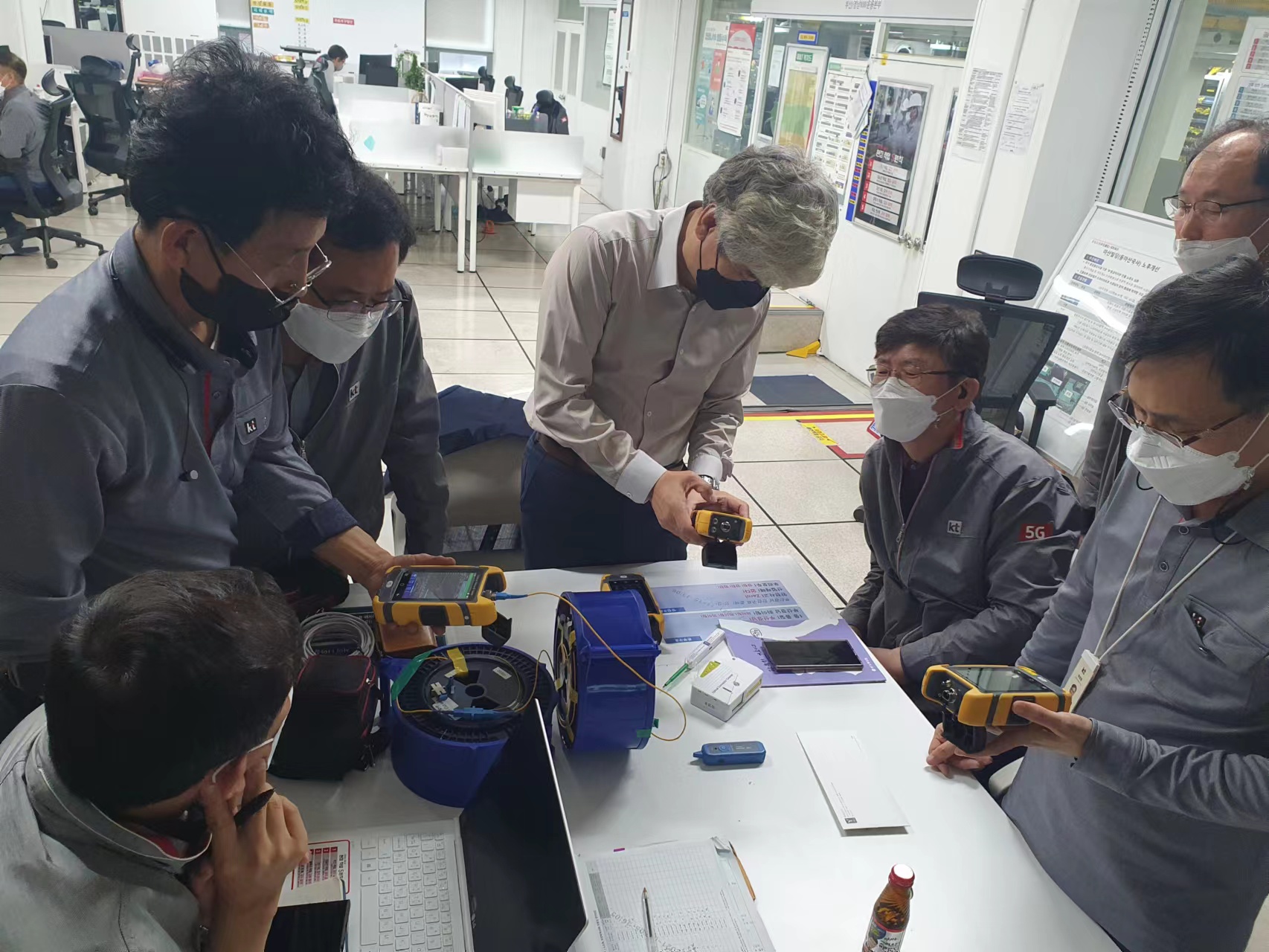
When KT Corporation — South Korea’s largest telecommunications operator and a global frontrunner in broadband innovation — began large‑scale testing of its next‑generation 10 Gigabit Passive Optical Network (10G PON), it quickly hit a measurement obstacle that no standard instrument could overcome. The answer lay in a very specific, out‑of‑band wavelength: 1650 nm. After a false start with conventional tools, KT turned to us. What followed was a journey of deep engineering, rapid field‑driven iteration, and a partnership that turned a bespoke requirement into a commercial‑grade reality.
The 1625 nm false start and the need for 1650 nmModern PON systems pack live traffic into tightly defined wavelength windows. KT’s 10G PON trial coexisted with legacy GPON services, meaning fibers carried downstream signals at 1490 nm alongside new 10G wavelengths. To verify fiber health without interrupting active services, KT initially evaluated a standard 1625 nm OTDR — the industry workhorse for GPON maintenance. The result was disappointing: when the 1625 nm probe light traveled through the same fiber carrying a 1490 nm signal, the OTDR trace showed strong interference. Rayleigh backscatter from the 1625 nm pulse combined with residual 1490 nm light leaking through wavelength‑division multiplexing filters, and the close spectral proximity also caused Raman‑induced noise. The trace became littered with ghost events and high noise floors, making it impossible to reliably locate connectors, splices, or splitter ports.
It was clear that 10G PON demanded a cleaner out‑of‑band testing wavelength — one that sat comfortably away from all revenue‑generating signals. KT specified 1650 nm. At this wavelength, complete isolation from 1490 nm, 1577 nm, and 1270 nm signals is assured, and the light can safely traverse high‑ratio splitters up to 1:64. Off‑the‑shelf 1650 nm OTDRs with the required dynamic range and ruggedness, however, simply did not exist.
Turning to a trusted partnerAfter multiple global test‑and‑measurement vendors could not deliver a custom 1650 nm solution within the aggressive network rollout timeline, KT approached our team. They already knew us for our willingness to co‑engineer where others only offered catalog products. Their mandate was clear: design, qualify, and supply a field‑ready 1650 nm OTDR that performed on par with or better than the finest 1625 nm instruments, and integrate it into their automated fiber monitoring ecosystem.
Engineering breakthroughsBuilding a high‑performance
1650 nm OTDR posed several photonics challenges. At this longer wavelength, Rayleigh backscatter is slightly lower and fiber attenuation marginally higher, directly squeezing dynamic range. Our R&D team focused on these,
- Stable, high‑power laser source. We developed a narrow‑linewidth 1650 nm laser with outstanding output stability, maximizing launch power while maintaining Class 1 eye safety for field use.
- Ultra‑sensitive receiver. A custom optical front‑end mated a low‑noise avalanche photodiode with a multi‑stage amplifier, dramatically improving weak‑signal detection after high‑loss splitter links.
- Smart signal processing. Proprietary algorithms suppress coherent noise and dead‑zone artifacts, delivering repeatable traces with sharp event resolution — critical for densely packed street cabinets and MDU (multi‑dwelling unit) wiring.
After months of iterative prototyping and rigorous lab validation, the first batch of 1650 nm OTDRs was delivered and passed KT’s demanding acceptance tests on the first attempt.
Field success and rapid, customer‑driven refinementsDeployment on KT’s live 10G PON test beds in urban, suburban, and MDU environments immediately proved the core measurement performance: in‑service testing with zero traffic interruption, an event dead zone under 1 m, dynamic range exceeding 37 dB, and seamless integration with KT’s automated monitoring platform. Technicians praised the clean, noise‑free traces that dramatically reduced mean‑time‑to‑repair.
Then, as with any real‑world tool, the field taught us more. On bright sunny days, field crews operating in direct sunlight outside street cabinets found the standard LCD screen hard to read. We responded immediately, qualifying a high‑contrast, anti‑glare display module and retrofitting all units. The enhanced screen readability turned a daily frustration into a non‑issue, and the feedback from technicians was overwhelmingly positive.
Another operational insight came directly from KT’s measurement workflow: to speed up the testing of hundreds of fibers per shift, operators wanted the software cursor to automatically jump to the first event and the last event as soon as a trace completed. This would allow instant length and loss checks without manual searching. Our algorithm engineers fine‑tuned the event‑detection logic and pushed a firmware update. The new auto‑cursor feature shaved precious seconds off every measurement and significantly boosted the daily testing throughput. KT’s operations team expressed deep satisfaction with the responsiveness.
A partnership built on customized innovationThe 1650 nm OTDR project exemplifies what we stand for: when standard equipment falls short, we do not wait for the market to catch up — we invent, and we listen. We moved KT from a failed 1625 nm evaluation to a tailored, full‑performance 1650 nm platform, then continued polishing the solution based on real field voices — a high‑contrast screen for sunlight, a smart cursor for speed. This iterative co‑innovation not only strengthened our relationship with a top‑tier Asian carrier but also expanded our optical test portfolio. Today, the same technology foundation is ready for other operators needing bespoke out‑of‑band testing wavelengths, whether for NG‑PON2, 25G PON, or future multi‑wavelength access networks.
Let’s go together with your next optical challenge
If your network demands a wavelength, a form factor, or a feature that does not yet exist on a data sheet, we invite you to challenge us. Our team thrives on turning complex specifications into reliable, high‑performance instruments that keep the world’s most advanced fiber networks running at peak performance — and we will keep refining until your field crews smile, even under the midday sun. Just as we did for KT.