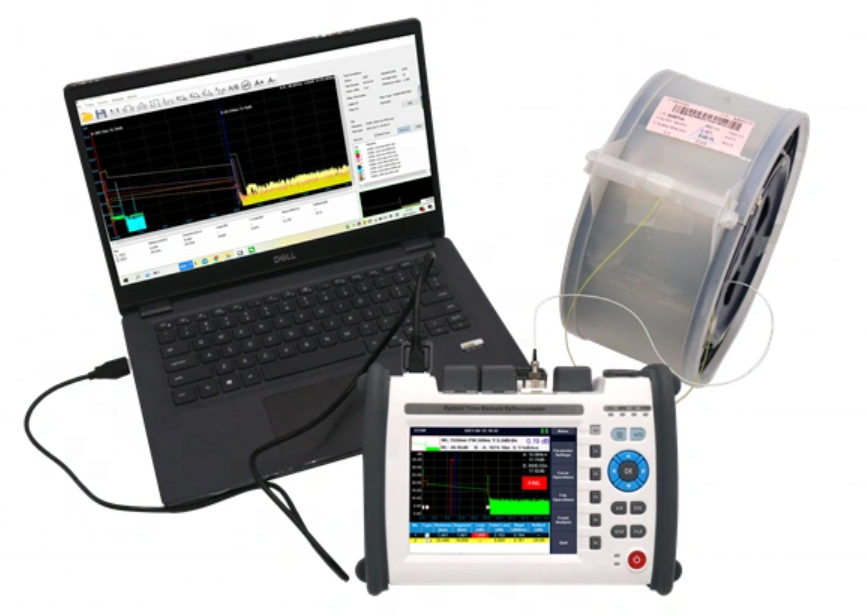
As service providers globally accelerate the rollout of XGS-PON and 10G-EPON to deliver multi-gigabit broadband, network maintenance teams face unprecedented technical hurdles. Legacy fiber testing tools that worked perfectly fine for standard point-to-point fiber or traditional GPON are now falling short.
In this technical deep dive, we will break down the complex wavelength architecture of 10G PON networks, explain why
traditional OTDRs fail in these environments, and look at how the FirstFiber Technologies 10G PON OTDR provides the ultimate all-in-one solution for both live troubleshooting and new network acceptance.
1. Understanding the 10G PON Wavelength Architecture
To understand how to test a network, we must first understand the light traveling through it. To achieve symmetrical 10G speeds while remaining backward-compatible with legacy GPON services on a single fiber, 10G PON (such as XGS-PON) uses Wavelength Division Multiplexing (WDM).
The spectrum is tightly crowded with specific operating wavelengths
- Downstream (OLT to User): Transmitted at 1577 nm to deliver 10G downstream data.
- Upstream (User to OLT): Transmitted at 1270 nm using a burst-mode for 10G upstream data.
- Legacy GPON Coexistence: Often runs simultaneously on 1490 nm (downstream) and 1310 nm (upstream).
- Maintenance & Testing: Historically assigned to 1625 nm / 1650 nm.
Because these wavelengths are constantly active in a live fiber environment, introducing an incorrect testing wavelength can severely disrupt the network ecosystem.
2. The Two Fatal Challenges of Using Traditional OTDRs on 10G PON
Many contracting teams attempting to maintain upgraded 10G PON networks with standard OTDRs inevitably run into two major roadblocks:
Challenge 1: The Impossibility of "In-Service" (Live) Testing
Traditional OTDRs typically emit test pulses at 1310 nm or 1550 nm. If a technician plugs a standard OTDR into an active 10G PON network, the OTDR's high-power laser pulses will clash directly with the upstream traffic, causing immediate service outages for all subscribers. Conversely, the continuous downstream blast from the OLT can flow backward into the OTDR, permanently burning out its sensitive optical receiver.
Challenge 2: "Blind Spots" Caused by High Splitter Ratios
10G PON architectures rely heavily on high-density splitters, often utilizing 1:64 or even 1:128 split ratios. A single 1:64 splitter introduces massive optical attenuation—roughly 18dB to 20dB of loss. Standard OTDRs lack the required dynamic range to punch through this barrier, leaving the technician completely blind to faults past the splitter.
3. How the FirstFiber Technologies 10G PON OTDR Solves These Problems
Engineered specifically for next-generation FTTH networks,
FirstFiber Technologies has introduced a dedicated
10G PON OTDR that directly addresses these pain points—not just in theory, but with real-world physics in mind.
Dedicated 1650nm Filtered Port for Superior Live Optical Isolation
While some standard live-testing OTDRs use a 1625nm wavelength, next-generation 10G PON networks demand stricter engineering parameters.
- The 1625nm Limitation: In XGS-PON, the downstream traffic blasts at a powerful 1577nm. Because 1625nm is spectrum-wise too close to 1577nm, standard built-in filters struggle to achieve high enough isolation. The massive 1577nm power often "bleeds" into the 1625nm receiver, blinding the OTDR.
- The FirstFiber 1650nm Advantage: FirstFiber utilizes a dedicated 1650nm wavelength for its live-testing port. By widening the guard band between the 1577nm downstream traffic and the OTDR testing wavelength, it achieves significantly higher optical isolation.
Even if the OTDR’s dynamic range isn't cranked to the absolute maximum, the physical separation of the 1650nm wavelength inherently ensures that the 1577nm live traffic never floods the OTDR sensor. Technicians can troubleshoot active lines with flawless accuracy and zero risk of crashing the customer's service.
5-Wavelength Offline Testing for Comprehensive Network Acceptance
Testing shouldn't only happen when the network is broken. During the construction phase of a new network (Greenfield deployment), you need to ensure the physical fiber plant can handle all 10G PON traffic before turning on the OLT lasers.
- The FirstFiber 10G PON OTDR features an offline testing mode that can emit all 5 key communication wavelengths representing the 10G PON / GPON spectrum.
- The physics of fiber optics dictate that different wavelengths behave differently under stress. For instance, longer wavelengths (like 1577nm) are highly sensitive to bending stress, making them perfect for catching hidden macrobends (tight kinks in the fiber cable) that shorter wavelengths (like 1270nm) might pass right through. Conversely, shorter wavelengths suffer higher Rayleigh scattering losses over long distances.
By sweeping the dark fiber with 5 distinct wavelengths, FirstFiber Technologies allows engineers to identify wavelength-specific anomalies, ensuring the network is 100% optimized and verified for day-one deployment.
High Dynamic Range Tailored for Splitter Loss
FirstFiber Technologies features an upgraded optical engine with optimized "PON Mode" algorithms designed to conquer heavy attenuation. When PON mode is activated, the device automatically adjusts pulse widths to penetrate cascaded splitters (such as a 1:8 followed by a 1:16).
Future-Proof Your FTTH Toolkit
As 10G PON deployment becomes the baseline for global broadband, relying on outdated test gear is a financial and operational risk. The FirstFiber Technologies 10G PON OTDR provides the complete toolkit.
For modern fiber technicians and ISPs, it isn't just an upgrade—it is an indispensable asset for the 10G era.
Ready to optimize your deployment and acceptance workflow?
Contact FirstFiber Technologies today to request a quote.